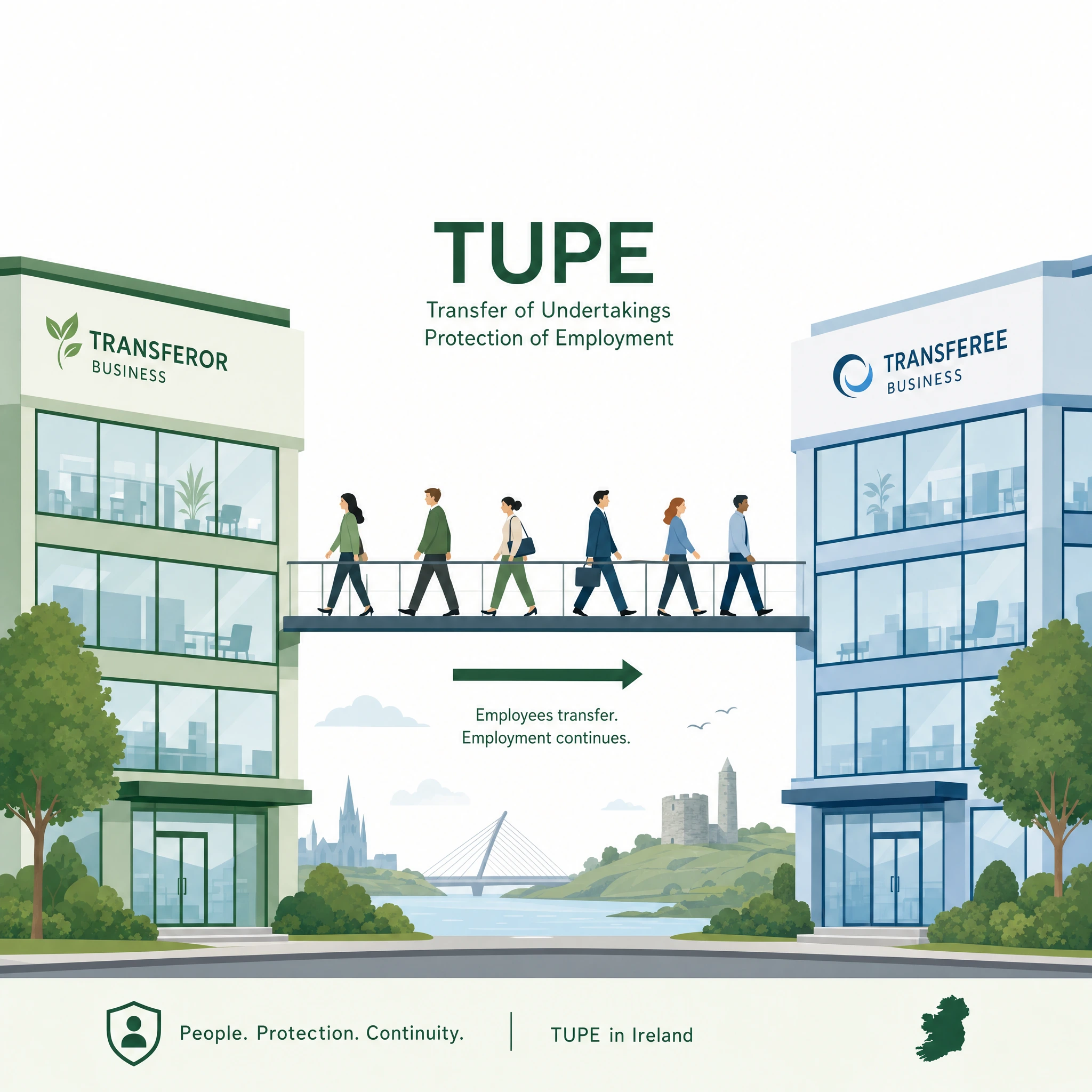
Small employers in Ireland buying or selling a business, division, or service, including asset sales and outsourcing arrangements.
Readers will gain practical steps to identify transferring employees, handle consultations, due diligence, and warranties, avoiding WRC claims and ensuring clean transactions.
Key Takeaways
- TUPE Ireland automatically transfers assigned employees and their terms when a business transfers as a going concern.
- Only economic entities retaining identity trigger TUPE; share sales do not.
- Contractual pay, benefits, leave, and service history transfer unchanged to buyer.
- Pre-transfer information and consultation with employees is mandatory to avoid claims.
- Dismissals linked to transfer are unfair unless ETO reason; prepare liability packs early.

When you buy or sell a business in Ireland, the people working in it do not simply come along for the ride. TUPE rules decide which employees transfer, on what terms, and what each side must do before the deal closes. Get it wrong and the buyer inherits unexpected claims, the seller carries warranty risk, and the employees land in a process they did not sign up for. This guide explains how TUPE Ireland works in practice for small employers, what transfers, what does not, and where the common traps sit. As of April 2026, the framework is set by the European Communities (Protection of Employees on Transfer of Undertakings) Regulations 2003, as interpreted by the WRC and the Labour Court.
What is TUPE and when does it apply in Ireland?
TUPE Ireland is the statutory regime that automatically transfers employees and their terms to a new employer when a business, or part of a business, changes hands as a going concern. The legal test is whether an "economic entity" retains its identity after the transfer.
TUPE typically applies to:
- An asset sale of a business or division
- An outsourcing or insourcing of a discrete service
- A service provision change between contractors
It typically does not apply to:
- A share sale, because the employer entity does not change
- A pure sale of assets where no organised economic activity transfers
- A transfer where the activity fragments and loses its identity
> The key difference is: in a share sale, employees stay put because their employer stays put. In an asset sale, TUPE moves them across to the buyer automatically.
Before you assume TUPE applies or does not, map what is actually being sold (people, contracts, equipment, customers) and ask whether the buyer can run the same economic activity on day one. If the answer is yes, plan for TUPE. Our guide to buying a business in Ireland covers how the employment side fits alongside the wider deal structure.
Which employees transfer under TUPE Ireland?
Only employees "assigned" to the transferring business transfer under TUPE Ireland. That sounds simple but in our experience, it is where most disputes start, especially in small companies where people wear multiple hats.
The practical tests are as follows:
- Assignment. Is the employee spending the majority of their working time on the transferring activity? If yes, they almost certainly transfer.
- Fixed-term and agency workers. Fixed-term employees on the relevant work transfer. Genuine agency workers usually do not, but review the actual working arrangements.
- Recent leavers and joiners. Employees dismissed shortly before a transfer can still be found to have transferred if the dismissal was connected to the sale.
- Objection rights. An employee can refuse to transfer, but doing so ends their employment without statutory redundancy in most cases.
> Please note: TUPE is automatic. Transfer happens by operation of law, not because anyone signs a new contract. Employees do not need to consent and the buyer cannot cherry pick who comes across.
Once you know who transfers, the next question is what travels with them.
Which terms transfer, and which do not?
Under TUPE Ireland, most contractual terms transfer unchanged to the new employer. The buyer inherits the same pay, hours, notice, benefits, and service history the seller was providing. Collective agreements in place before the transfer continue to bind the buyer.
What usually transfers:
- Salary, bonus structures, and allowances
- Annual leave and public holiday entitlements
- Notice periods and restrictive covenants
- Contractual policies (where expressly incorporated)
- Continuity of service, including accrued rights
What does not automatically transfer or needs separate treatment:
- Occupational pension rights (special rules apply; take advice)
- Share options and equity awards (usually not capable of transfer without separate arrangements)
- Purely discretionary benefits that were never contractual
> Author's tip: Ask the seller for a full employee liability information pack early. Salary is the easy part. The buried items are enhanced sick pay, long service awards, and historic side letters. These are the terms the buyer inherits whether they knew about them or not.
With terms clear, the next stage is the process both sides must follow before completion.
What information and consultation duties apply?
Employers on both sides of a TUPE transfer must inform, and where appropriate consult, affected employees or their representatives before the transfer takes place. We have seen that skipping this step is one of the most common causes of WRC claims after a sale.
The minimum information both sides must provide:
- The fact that a transfer is happening and the approximate date
- The reasons for the transfer
- The legal, economic, and social implications for employees
- Any "measures" (changes) planned for employees in connection with the transfer
Where measures are proposed, consultation must happen in sufficient time to allow genuine engagement. In a small company with no union or employee representatives, the employer should consult with affected employees directly.
Document every step. A clear paper trail of letters, meetings, and questions answered is the single best defence against a later claim that consultation was a rubber stamp. Our grievance procedure guide for small Irish employers covers how to run process-heavy employment conversations cleanly.
What about dismissals and changes after a TUPE transfer?
Dismissals connected to a TUPE transfer are automatically unfair unless the employer can show an "economic, technical, or organisational" (ETO) reason involving changes in the workforce. Post-transfer harmonisation of terms is equally restricted.
The core rules:
- Pre-transfer dismissals. A dismissal made because of the transfer is automatically unfair on both sides.
- Post-transfer dismissals. Allowed only where there is a genuine ETO reason, for example a restructuring that would have happened regardless.
- Term changes. Changes to terms that are by reason of the transfer are void, even if the employee agrees.
- Redundancy exposure. Genuine post-transfer redundancies follow the normal process, but the transferring service counts toward entitlements.
> In practice, this means: the buyer inherits the seller's workforce on the seller's terms, and cannot "tidy up" contracts in the first months without a defensible ETO reason.
With the risks mapped, the final question is how buyers and sellers should actually prepare for the deal.
How should buyers and sellers prepare for TUPE?
Run TUPE as a workstream inside the deal from the first heads of terms. Treating it as a legal formality at completion is how small employers end up with post-close WRC claims and warranty calls.
For sellers:
- Prepare a full employee liability information pack: contracts, policies, benefits, claims history.
- Map who is "assigned" to the transferring business and document the rationale.
- Start information and consultation at the right time, not the day before signing.
For buyers:
- Run TUPE-specific due diligence alongside commercial and financial review.
- Negotiate warranties and indemnity clauses covering pre-transfer employment liabilities. Our guide to investment and transaction warranties covers how these clauses are typically structured.
- Plan day-one communications, payroll integration, and benefit parity.
Both sides should agree on the allocation of pre-completion employment liabilities in writing. This is usually handled in the sale and purchase agreement through specific warranties, a disclosure letter, and sometimes a dedicated indemnity.
> Get a TUPE-ready deal pack before you sign Open Forest prepares employee liability information packs for sellers and TUPE due diligence reports for buyers, so the people side of the deal is closed out before completion day. Book a TUPE review.
Where this leaves you
TUPE Ireland is not optional and it does not bend around deal timetables. When a business transfers as a going concern, the employees, their terms, and their service history move with it. The work for both sides is to identify who is in scope, document the terms, run a proper information and consultation process, and draft the deal documents to reflect the real liabilities. If you are buying or selling a business and want a clean path through TUPE, Open Forest can map the employee side of the transaction with you before it becomes a last-minute obstacle.

Laura Ryan is a practising Barrister at the Bar of Ireland. She graduated from the Honourable Society of King’s Inns in 2024, having previously qualified and practised as a Chartered Accountant in a big four accounting firm.